

Find out where your website is leaking sales, and what to fix first.
A CRO audit is a top-to-bottom look at how people really use your website. It shows you three things:
- where conversion is leaking today
- what's worth fixing, and what is just noise
- which changes are most likely to pay for themselves quickly
I've carried out more than 30 of these since 2018, for ecommerce brands, subscription businesses, B2B and lead generation sites and software companies. It's where most of my client work starts.
Rated 5.0 on Google.
Book your free CRO consultation
What an audit usually uncovers
Every site is different, but some things turn up again and again.
- Most visitors never see a product. On store after store, more than half of visitors have left without reaching a single product page.
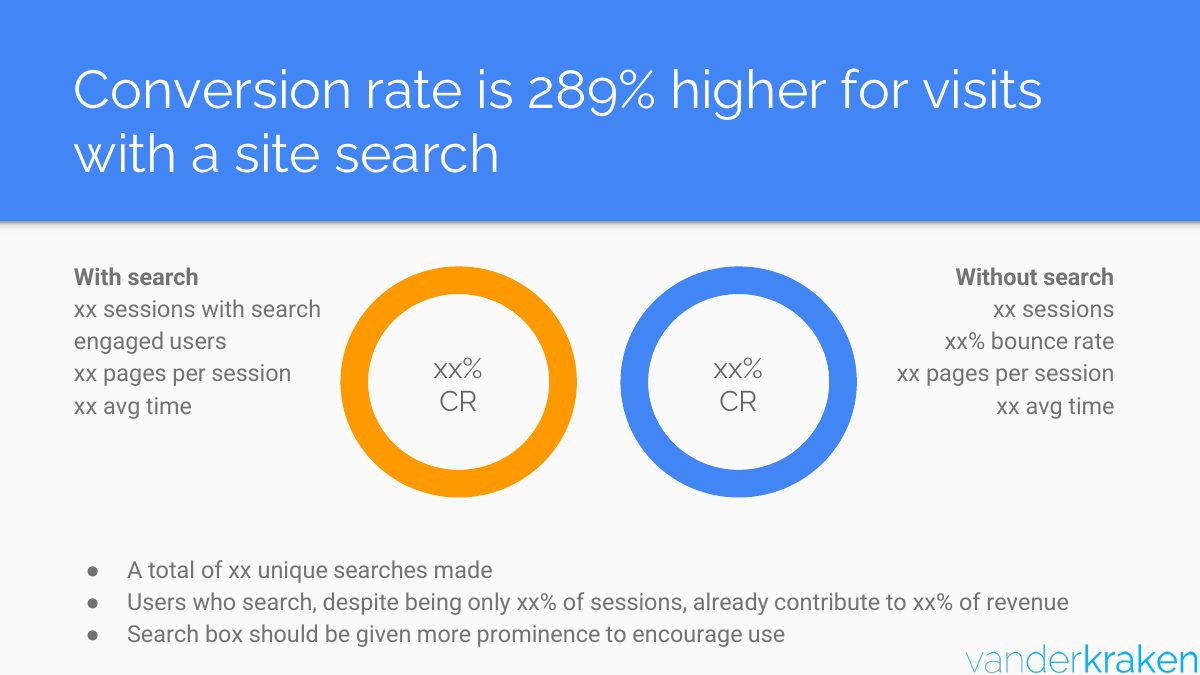
- People who search buy far more often. Visitors who use site search have converted at three to ten times the rate of those who don't, on sites where the search box was hard to find.
- Mobile brings the visits, desktop brings the sales. The gap between the two is often the biggest single opportunity.
- Blog readers stay on the blog. Content pulls in traffic that never makes it to the shop.
- The leak isn't where the team thinks it is. A business convinced its checkout is broken often turns out to be losing people three steps earlier.
- The tracking is wrong. Double-counted pages and missing events are common, and they mean decisions are being made on bad numbers.
And sometimes the answer is that the site is in good shape. If nothing major is wrong, I'll say so, tell you what's worth testing next, and not invent problems to justify the report.
Who a CRO audit is for
- Ecommerce and subscription brands with healthy traffic and too few orders.
- Lead generation sites where the forms and calculators get visits but not enough enquiries.
- Software companies losing people between sign-up and first use.
- Teams about to start A/B testing who want test ideas backed by evidence, not opinions.
- Businesses with a big moment coming, such as a redesign, a launch in a new market or peak season, who want the site ready before it arrives.
What I look at
The numbers show where the problems are. Watching and listening to real people shows why they happen. A full audit uses both.
Technical analysis
Bugs, page speed, broken links, browsers and devices. Anything that gets in the way before a visitor has read a word.
Heuristic analysis
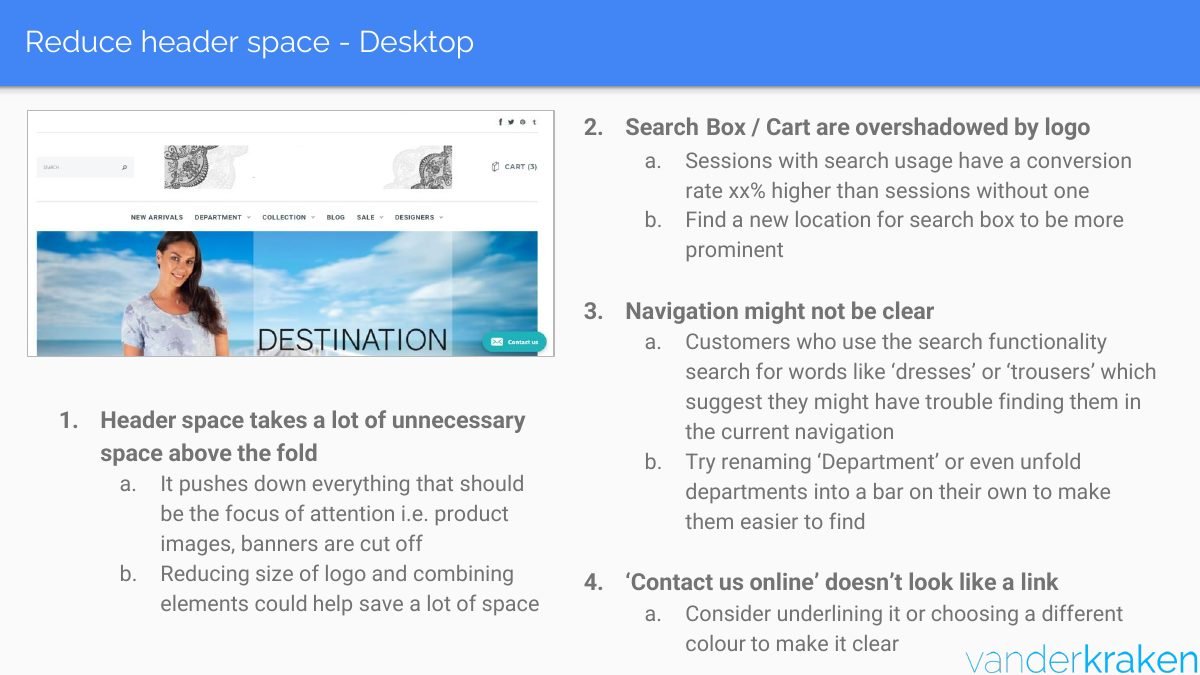
A page-by-page review of your key journeys, from homepage to checkout, judged the way a buyer would judge them: is it relevant, is it clear, does it motivate, and where is the friction?
Quantitative analysis
Your analytics, taken apart step by step and split by device, channel, country and new versus returning visitors, to find where people drop out and where the biggest opportunities sit. I check the data is clean first, so automated traffic and tracking errors don't skew the picture.
Qualitative analysis
Heatmaps, scroll maps and session recordings to see how people really behave on each page, and surveys to hear it in their own words.
User testing
I run remote user testing sessions and watch real people try to complete a purchase or an enquiry on your site. Nothing shows you where visitors get stuck faster than seeing it happen.
Voice of the customer
Customer service chats and past research are often full of clues about what confuses people. If you have them, I'll use them.
What you get
A full report, not a list of opinions. A typical audit runs to 40 to 70 pages. Every finding comes with the evidence behind it and a recommendation next to it.

- An executive summary that names the areas of highest potential uplift and, where the data allows, puts a yearly money value on the gap.
- Findings for each stage of the journey: homepage and navigation, listing pages, search and filters, product pages, basket and checkout.
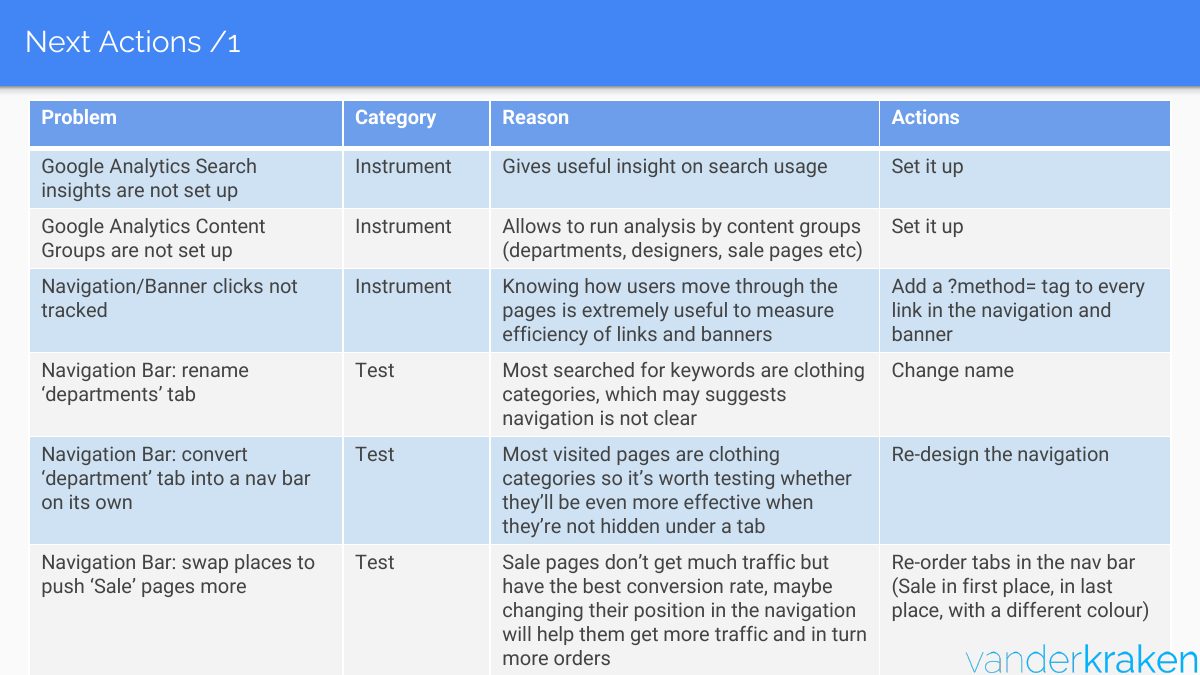
- Everything sorted by type: quick fixes, A/B test opportunities, tracking gaps and bigger strategic improvements.
- A prioritised action plan: what to do first, what to do next, and what can wait. High impact and low effort goes to the top.
- A run-through session. I send the audit first so you can read and digest it. Then we go through it together and I answer your questions.
- Help getting the quick fixes live. I'm happy to talk to your developers directly, so the audit doesn't end up as a report sitting on a shelf.
Clients tend to act on it quickly. One had already made some of the changes before we'd even had the run-through call. Another had raised tickets with their developers within three days.
"Dario provided a highly detailed and data led CRO audit for our lead generation website. He's a pleasure to work with and great communicator, giving clear actionable advice and recommendations to improve website conversion rate."
James Myers, Google review
"Dario conducted an excellent CRO audit of our website with detailed recommendations on improvements that can be made, including user testing and user data."
Ryan Fleming, Google review
How deep it goes is up to you
Not every business needs the same audit, and not every budget stretches to the full version. So the depth is flexible.
- A leaner audit covers the analytics, the heuristic review and the heatmaps. It gives you a clear, data-informed direction and a prioritised list to run with.
- A full audit adds session recordings, user testing and competitor analysis, plus my help with implementation. The findings are validated by watching real people, so the recommendations come with more certainty.
Tell me your budget in the consultation and I'll tell you honestly what it buys.
Want to see one first?
I've got two sample audits, one for an ecommerce site and one for a lead generation site, with the client details removed. Ask in your consultation request and I'll send them over, so you can see the level of depth before you decide anything.
What happens after the audit
Some fixes are obvious and go straight in. Others need testing first. That's where the audit becomes an A/B testing programme, usually planned three to six months ahead.
There's no obligation to carry on once the audit is done. Any testing work is a separate project, and plenty of teams take the action plan and run with it themselves.
Here's what's possible when you do carry on, from a pet food subscription brand I worked with:
- Month one: I audited the site, focusing on the sign-up funnel.
- Month two: the first round of changes, mostly for mobile users, lifted the conversion rate by 63%.
- A year later: continuous A/B testing and user research had taken the total uplift to 83%, through an economic downturn and a price increase.
How it works
- Free consultation. We talk about your site, your goals and your numbers. Usually 20 to 45 minutes, with no obligation.
- Access. You give me view access to Google Analytics and to whichever tool you use for heatmaps and recordings, such as Hotjar, Microsoft Clarity or Mouseflow.
- The audit. This typically takes three to four weeks. If you have a deadline, such as a launch or peak season, we plan backwards from it.
- Your report. I send it over for you to read in your own time.
- The run-through. We go through the findings together, with time for questions, and agree what happens first.
Questions people ask
How long does a CRO audit take?
Three to four weeks from the day I have access to your data.
What do you need from me?
View access to Google Analytics and to your heatmap or recording tool. Past user research and recent customer service chats help too, if you have them.
What if you don't find anything wrong?
Then you'll know your site is sound, which is worth knowing. I'll tell you plainly and point you to the experiments most likely to move things further.
Is my data kept confidential?
Yes. Confidentiality is written into every agreement, and I never publish a client's figures or findings without their say-so.
What's the difference between a CRO audit and A/B testing?
The audit finds the problems and ranks them. A/B testing proves which fix works by showing two versions to real visitors. The audit comes first, because it tells you what's worth testing.
Do I have to commit to A/B testing afterwards?
No. The audit stands on its own.
Do you only work with companies in London?
No. I'm based in London and work with clients in the UK, the Netherlands, the US, Australia and New Zealand.
Book your free CRO consultation
Tell me about your site and I'll reply by email within 24 hours to arrange a call. It's free, and you're under no obligation to go any further.

Dario van der Kraken
CRO consultant, London